 Video Diary
The big mood trackers don't record video. Daylio and How We Feel will take a photo or a voice memo with your mood, and that's where they stop. If you want to tap a mood and talk to the camera about it, you have three real options on iPhone: Apple Journal, which is free and lets a mood and a video share one entry; TalkBook, which transcribes what you say and runs AI analysis on it; and Video Diary, which I make, and which is a video diary first with a mood on every entry and no AI anywhere. Which one fits depends mostly on whether you want to search your entries or watch them.
Which mood tracker apps let you record video?
| App | Video entries | Mood insights | AI on entries | Price (US) |
|---|---|---|---|---|
| Video Diary | Yes, the video is the entry | Mood per entry, Insight view | None | Free; Premium $6.99/week or $44.99/year |
| Apple Journal | Yes, attached to a written entry | State of Mind, charted in Health | Prompts from your activity; nothing scores your mood | Free, built in |
| TalkBook | Yes, transcribed on device | Mood per entry, weekly sentiment | Yes, sentiment and themes | Free to download, in-app purchases |
| Daylio | No (photos and voice memos) | The best stats of the five | None | Free; Premium $4.99/month or $35.99/year |
| How We Feel | No (photo and voice memo) | Emotion words, Health data patterns | None | Free, nonprofit |
How I compared them
- Can you record video in the entry, not just attach a photo? This is the question the search is asking, and it rules out most mood apps.
- Does the mood become something you can look at? A mood you log and never see again is just a tap.
- Who decides your mood: you, or a model? Some apps let you pick it. Others infer it from your words or your face.
- How many taps from the home screen to logging today? Mood tracking only works if you do it on the bad days too, and on bad days you have less patience.
- What it costs to keep using it, not just to download it.
The apps
Video Diary: a video diary with a mood on every entry
Best for: people who want to talk through the day on camera and see their moods across months, with nothing processing what they say.
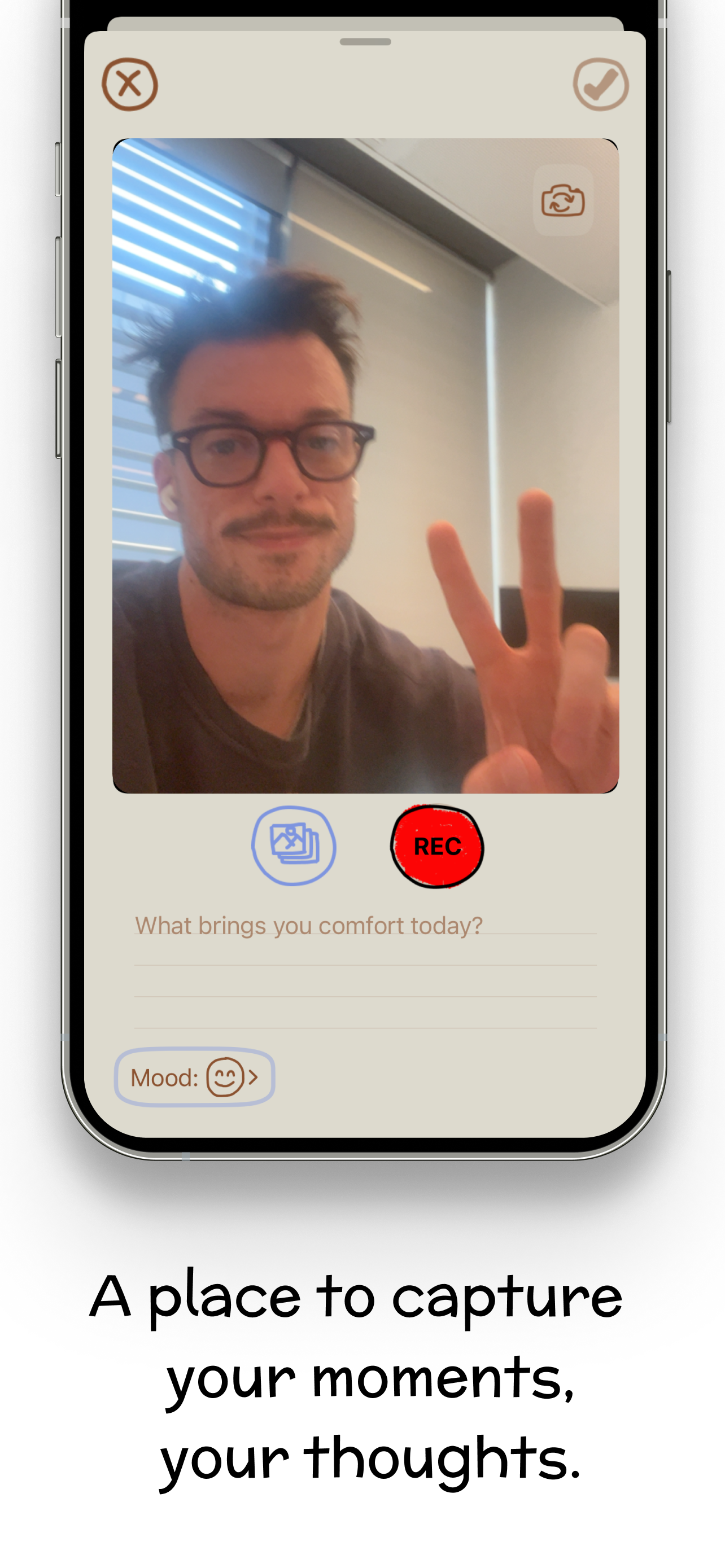
This is mine, so weigh the praise accordingly and pay attention to the criticism. The app opens on the camera. You tap REC, talk, and the entry lands on a calendar with a mood you pick and an optional written note. The Insight view shows how your moods spread over time, and the calendar shows the days themselves as video thumbnails, so a run of bad days isn't just a dip in a chart: you can tap into one and hear yourself explain it. There's a reflection prompt on the record screen if you don't know what to say, and a montage maker for when you want to watch a month back.
Where it loses: its mood analysis is simpler than Daylio's. There are no correlations between activities and moods and no PDF reports. And because nothing listens to your entries, you can't search what you said, only the notes you typed. It's iPhone, Apple silicon Mac and Vision Pro only. No Android, and it isn't a native iPad app. Recording is free every day. Premium ($6.99 a week or $44.99 a year in the US) adds palettes, fonts, Face ID lock and iCloud backup. Without it, your videos live only on your device.
Apple Journal: free, and the mood goes to Health
Best for: people who mostly write, sometimes film, and want their mood alongside sleep and exercise in the Health app.
Journal can record a video inside an entry, and since iOS 18 it can also add a State of Mind. You slide from very unpleasant to very pleasant, pick words for the feeling and what's behind it, and the log is saved to Health. Both sit in the same entry. It costs nothing, it's already on your phone, and Health turns those logs into charts next to your sleep and workouts, which no third-party app here can match as neatly.
The catch is that it's a written journal with video attached. Every entry starts as a page of text, past entries scroll by as a feed, and long recordings can hit an attachment size limit. I've written a full look at how Apple Journal handles video if it's the one you're leaning towards.
TalkBook: video with transcripts and AI analysis
Best for: people who want to find things later, such as every entry where they talked about work, and who are comfortable with AI reading their entries.
Its App Store name is "Video Journal & Easy Diary". You record, it transcribes your speech on the device in more than 50 languages, and you pick one of five moods. It also attaches weather, location and steps automatically, and runs an AI analysis that reports weekly sentiment, recurring themes and recommendations. The searchable transcripts are a real advantage over Video Diary. Six months from now you can type a word and find the night you said it. My app can't do that.
The trade-off is the analysis. A model is reading your diary and drawing conclusions about you. You can switch off the location and weather tracking, but the analysis is the point of the app. It's also young, with 20 ratings on the US store, so it has less track record than anything else here.
Daylio: the best mood tracker, no video
Best for: people who want a fast daily mood score and real statistics, and don't need to film.
Daylio is the app the category is measured against, with 4.8 stars from about 62,000 ratings in the US. You pick a mood, tap the activities that filled your day, and you're done in seconds. Its stats are what the others lack: which activities line up with your good days, how your mood moves week to week, and a whole year of moods on one screen. Entries can hold a note, up to nine photos and a voice memo. Premium ($4.99 a month or $35.99 a year in the US, with a 7-day trial) adds advanced stats, PIN lock, automatic backups and PDF export.
It has no video. If you love Daylio and want a face and a voice for some days, keep it. Run a separate video diary for the days you have something to say. The two jobs don't get in each other's way.
How We Feel: for finding the word for the feeling
Best for: people who know they feel bad but can't say how, and want help naming it.
Built by a nonprofit with Yale's Center for Emotional Intelligence, How We Feel is free with no subscription. A check-in asks you to place your feeling by energy and pleasantness and then choose the precise word. There's a reason that step matters: a 2007 brain-imaging study by Lieberman and colleagues found that putting a feeling into words reduced the amygdala's response to it. Check-ins can include a photo and a voice memo, it reads sleep and exercise from Health to find patterns, and it has short video strategies for regulating a feeling in the moment. Your data stays on the device unless you opt in to sharing it anonymously for research.
The videos are the app's lessons, not your entries. There's nowhere to record yourself.
Why put a video next to your mood?
A mood log compresses a day into one number. That's its strength: in three months you can see that Sundays are bad, or that March was. But the score can't tell you why March was bad, and by June you won't remember either.
A minute of video keeps the reason. Your face, your voice and the thing you were stuck on that week carry what a "2 out of 5" throws away. The mood shows you where to look, and the video shows you what was there.
That's also the honest case for keeping it simple. If logging takes more than a minute, you'll skip the days that matter most, because those are the days you least want to do it. I've written more about using a video diary for self-reflection, including how to keep it kind rather than another place to judge yourself.
What about apps that read your mood from your face?
They exist. MoodMirror, for example, says its AI analyses your video to detect your mood and chart it over time. I'd be careful for two reasons. First, the mood you name is information: deciding whether today was a 3 or a 4 is part of the reflection, and a model's guess skips it. Second, it means software is studying your face and your words in the most private recordings you make. Some people are fine with that. If you aren't, it rules out a growing share of new journaling apps, and I've tracked which journals still keep AI out.
Which one should you pick?
- You want a mood score in five seconds and good charts: Daylio. Add a video app later if you miss the faces.
- You want help naming feelings, for free: How We Feel.
- You mostly write, and want mood in the Health app: Apple Journal.
- You want to search what you said, and AI is fine with you: TalkBook.
- You want to talk to the camera most days, tag a mood, and keep it private: Video Diary.
- You're on Android: Daylio and How We Feel both have Android versions. Video Diary and Apple Journal don't.
A mood you can rewatch
Video Diary opens on the camera. Tap REC, say what's going on, pick a mood, and the day lands on your calendar. The Insight view shows the pattern, and every day in it has your own explanation attached. No account, no feed, no AI.
Free for daily journaling on iPhone (iOS 17.6+), Apple silicon Mac and Vision Pro. It has 4.5 stars from 39 ratings on the US App Store, which is a small base, so treat it as a signal rather than proof. Premium is $6.99 a week or $44.99 a year in the US and adds palettes, fonts, Face ID lock and iCloud backup, not the ability to record. Try Video Diary free. No Android version.
Frequently asked questions
Can you add video to Daylio?
No. Daylio entries can hold a note, up to nine photos and a voice memo, but not video. If you want Daylio's quick mood log and also want to film, the simplest setup is to keep Daylio for the daily tap and a separate video diary for the days you have something to say.
Learn more: video journaling apps compared →Is there a free mood tracker that records video?
Yes. Apple Journal is free on iPhone and lets you add a State of Mind and a recorded video to the same entry, with the mood saved to the Health app. Video Diary is also free for daily recording with a mood on every entry; its Premium tier adds palettes, fonts, Face ID lock and iCloud backup.
Can an app detect my mood from a video?
Some apps claim to. They analyse your face or transcribe your speech and score the sentiment with AI. That requires software to process what you said and how you looked, and a score inferred by a model is not the same as the mood you name yourself. If you want a private record, pick an app where you choose the mood.
Learn more: what a private video diary needs →Is a mood tracker a substitute for therapy?
No. A mood log can help you notice patterns and give you something concrete to bring to a therapist or doctor, but it doesn't diagnose or treat anything. If your low days are outnumbering the others, or you're thinking about harming yourself, talk to a professional or a crisis line rather than an app.