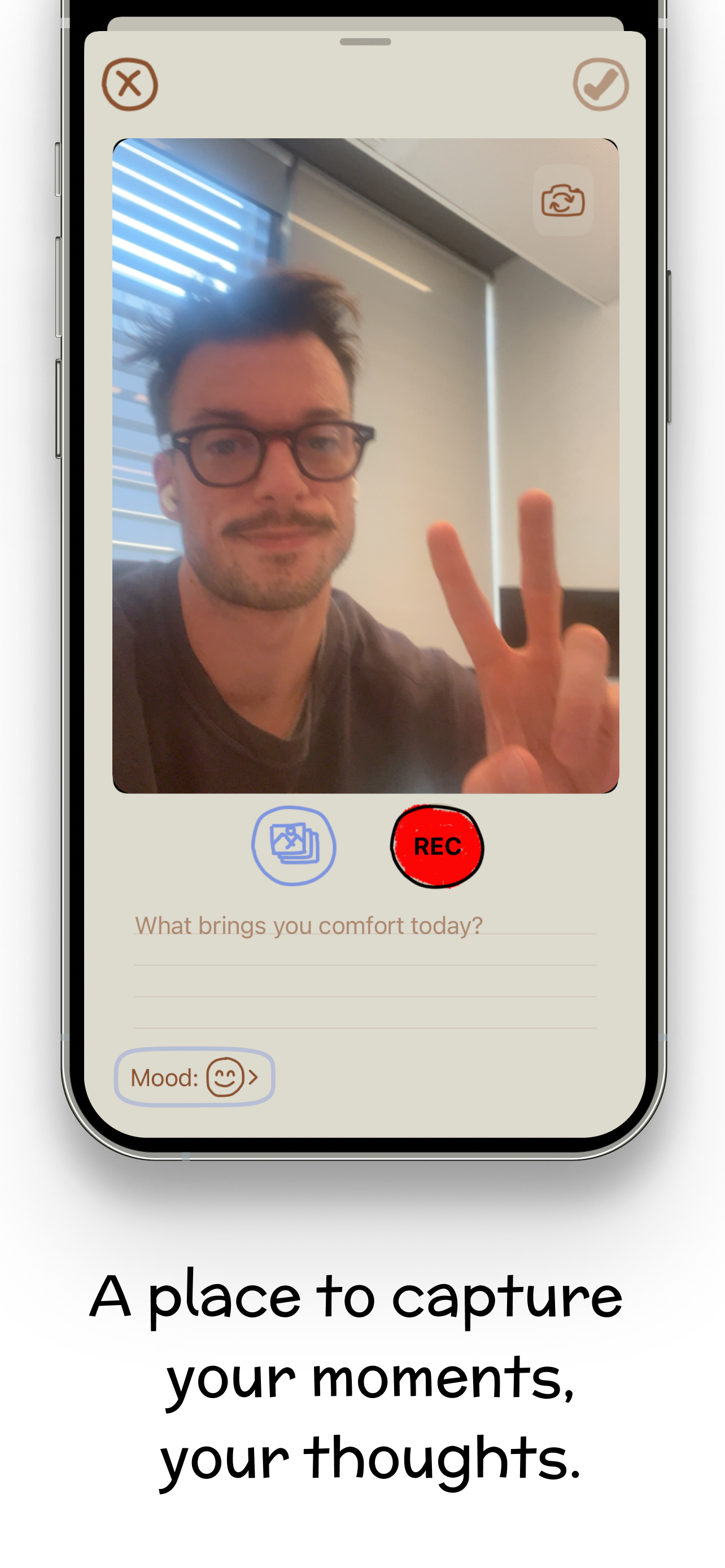
 Video Diary
Therapists have recommended journaling for decades, and the research behind expressive writing — lower stress, better emotional regulation, improved self-awareness — is some of the most replicated in psychology. Video journaling delivers the same mechanism through a lens instead of a pen, and adds a few effects writing can't reproduce. Here's how it helps, and how to do it in a way that's kind to yourself.
Talking to the camera is structured thinking
A worry in your head is a loop; a worry said out loud is a sentence. Speaking forces vague dread into concrete words — what exactly is wrong, since when, what would help — and that translation is where most of the relief comes from. Psychologists call it cognitive processing; you'll experience it as the odd lightness after you stop recording, as if the phone is now holding the worry so you don't have to.
The camera reflects what a page can't
When you rewatch an entry, you see yourself the way you'd see a friend: tired, trying, more sympathetic than the voice in your head suggested. People are consistently kinder to their recorded selves than to their in-the-moment selves. Watching last month's you — who survived the thing you're worried about now — is a dose of perspective no written paragraph delivers.
Mood tracking turns feelings into patterns
Tag each entry with a mood and something powerful happens over weeks: your emotional life gets a shape. You notice that the dread peaks on Sunday nights, that you're consistently better after seeing people, that the "bad month" was actually four bad days. Patterns like that are exactly what a therapist would help you look for — a mood-tagged video diary does the collecting for you.
How to practice it safely and kindly
- Keep entries short (1–3 minutes). Venting has diminishing returns; long spirals on camera can rehearse distress instead of processing it. Say it, name it, close the app.
- End with one stabilizing question. After the hard part, answer something like "what's still okay?" or "what's one thing I can do tomorrow?" — it closes the entry with agency instead of spiral.
- Don't force daily perfection. Journal when there's something to process; a missed week is not a failure.
- Privacy is a precondition. You will not be honest with an app you don't trust — use one with no AI analysis, no cloud processing, and a Face ID lock. (Here's what a truly private video diary looks like.)
- Know the limits. A video diary is a tool for reflection, not treatment. If you're dealing with persistent depression, anxiety, or crisis, talk to a professional — the diary can support that work, not replace it.
Getting started on a hard day
Skip the setup. Open the camera, and answer just one of these: What's the feeling, and where do I notice it? What would I tell a friend who felt this? What's one thing that's still okay? One take, no rewatch required. (More in our 30 video journal prompts — including a section for hard days.)
How Video Diary supports the practice
- Zero-friction recording: on the days you least feel like journaling, the app opens straight to the camera — the whole entry costs two minutes.
- Daily reflection prompts like "What brings you comfort today?" give hard days a gentle starting point.
- Mood tracking + Insight view: tag every entry and watch your patterns become visible over weeks.
- Genuinely private: no AI reading your entries, no feed, Face ID lock — so you can say the true version, not the presentable one.
Download Video Diary free — and tonight, say the thing out loud once. That's the whole assignment.